
Sardinia: guide and tourist information
History, traditions and lots of useful information to help you organise your holiday in Sardinia.
« Life in Sardinia is maybe the best a man can hope for: twenty-four thousand miles of forests, of countryside, of coasts surrounded by a miraculous sea should coincide with what I would recommend the good God to give us as paradise. » (Fabrizio De Andrè, Italian poet and musician)
What are you looking for? History | Traditions | How to get there | Places to see | Wonderful beaches
Where it is
Sardinia is the second largest island in Italy, and is situated in the middle of the Mediterranean. It is immediately to the south of Corsica (which belongs to France). It can be reached in 5 hours by ferry from Rome, 7 from Nice or by plane from several different international airports.
The largest footprint of the Mediterranean
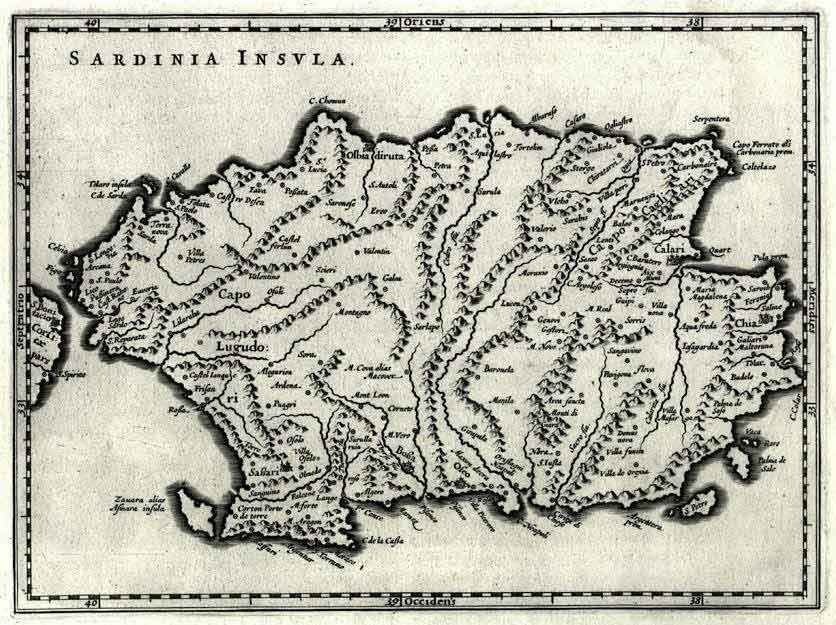
The Greeks called it Hyknusa or Ichnussa (Ιχνουσσα), from the greek Ichnos (footprint of human foot) because of its similarity to a large footprint; however, Sardinia takes its name from the Latin Sardinia, as the Romans called it. In fact, the name Sardinia was already known to the Phoenicians, as witnessed by the Nora Stele, the oldest written document found in western Sardinia, precisely in Nora, where we read b-šrdn = In Sardinia.
More faces of the same island, more aspects of a single land
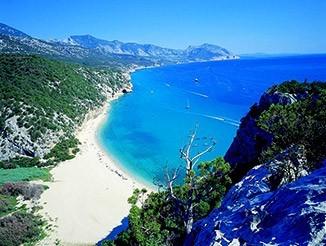
Don't you know where is Sardinia and what does it can offer you? Are you wondering: is Sardinia part of italy? Well, discover it right know. With its 1840 km of coastline, Sardinia is the Italian region with the largest coastal development; the sea is clear and practically preserved from every kind of pollution. Many Sardinian beaches are nowadays nationally and internationally well known, as those of Villasimius, of the Costa Smeralda (the Emerald Coast) and of Alghero, which are among the favourite destinations for holidays in the island. On the contrary, many other beaches, equally beautiful, have managed to maintain their wild nature subtracting themselves, in whole or in part, to mass tourism. This is the case of Berchida beach, of some of the beaches of Ogliastra and Oristano provinces. From your beach hotel you can freely move and visit the nearby beaches, or heading into the interior to explore the more remote parts of Sardinia.
You will be fascinated by the small coves that lie in wild corners of the crystalline seas, you will be astonished to see the wonders that nature, with patience over the centuries, has created in the spectacular caves that penetrate the heart of the island.
Being a so ancient land, the erosion of wind and rain has made that Sardinia has no high mountains; nevertheless it is mostly mountainous, characterized by plateaus and group of hills.
There are many historical and archaeological sites in the region; the most famous are definitely the Nuraghes: there are more then 7,000 exemplars scattered throughout the island, one every 3 km2, representing the most impressive megalithic monuments in Europe. They are present only in Sardinia: where is the most important? In Barumini, its name is Su Nuraxi.
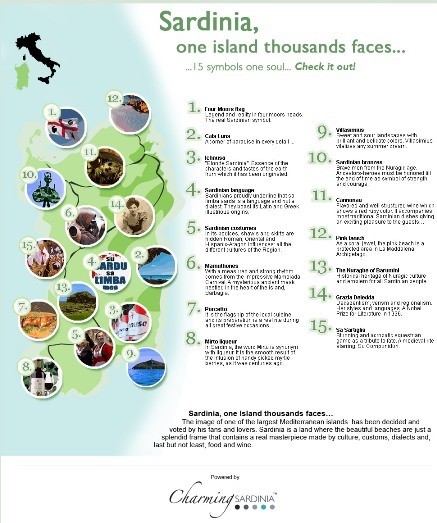
CharmingSardinia.com has decided to collect the different aspects of Sardinia, in order to identify which are the most appreciated and representative of the island. It has therefore identified 30 and subjected them to a popular vote: the result is this nice infographic composed by 15 symbols, the most voted by Sardinians and Sardinia lovers.
You will be fascinated by the small coves that lie in wild corners of the crystalline seas, you will be astonished to see the wonders that nature, with patience over the centuries, has created in the spectacular caves that penetrate the heart of the island.
Being a so ancient land, the erosion of wind and rain has made that Sardinia has no high mountains; nevertheless it is mostly mountainous, characterized by plateaus and group of hills.
There are many historical and archaeological sites in the region; the most famous are definitely the Nuraghes: there are more then 7,000 exemplars scattered throughout the island, one every 3 km2, representing the most impressive megalithic monuments in Europe. They are present only in Sardinia: where is the most important? In Barumini, its name is Su Nuraxi.
CharmingSardinia.com has decided to collect the different aspects of Sardinia, in order to identify which are the most appreciated and representative of the island. It has therefore identified 30 and subjected them to a popular vote: the result is this nice infographic composed by 15 symbols, the most voted by Sardinians and Sardinia lovers.
Is Sardinia part of italy? Yes, but with its own particularities: nature, culture, traditions
Many consider Sardinia the "less Italian" among all regions: the geographical isolation has, in fact, allowed the development of indigenous plants and animal species (as the mouflon or the white donkey from Asinara), and has maintained its linguistic peculiarities and its ancient traditions, which have remained intact over the centuries.
For your holidays, Sardinia has much to offer apart from the sea: your stay in one of our selected hotels will allow you to discover the lesser-known faces of this ancient and charming land and to visit the most enchanting Sardinian places.
For your holidays, Sardinia has much to offer apart from the sea: your stay in one of our selected hotels will allow you to discover the lesser-known faces of this ancient and charming land and to visit the most enchanting Sardinian places.
Food & Wine in Sardinia
If you are a gourmet, our selection of Hotel Gourmet will give you a hand in choosing the Hotel in Sardinia that suit your vacation! Passing by Cagliari? Here is the Must-try food and wine experience you cannot miss!
How to get to Sardinia
Three airports bring you to Sardinia and their traffic load varies with the seasons. The southern coast is served by Cagliari Airport, within easy reach of the Ogliastra region. The Airport of Olbia-Costa Smeralda is dedicated to the whole area of Olbia and the north east coast, while the western coast is mainly served by the Airport of Alghero.
Direct flights are available from the UK (London, Birmingham), from Germany (Frankfurt, Berlin, Memmingen), from France (Bordeaux, Paris, Nantes, Lyon and many other cities) from Switzerland (Geneva, Zurich, Bern, Basil) and from Italy (Milan, Bologna, Rome and many other cities).
To reach Sardinia by ferry, we remind you the main ports are: Porto Torres, Golfo Aranci, Arbatax, Olbia and Cagliari.
Tirrenia, Moby, Grimaldi, Corsica Ferries and GNV operate ferry services bringing millions of visitors each year to the island. The trip lasts from 11 to 5 hours.
Direct flights are available from the UK (London, Birmingham), from Germany (Frankfurt, Berlin, Memmingen), from France (Bordeaux, Paris, Nantes, Lyon and many other cities) from Switzerland (Geneva, Zurich, Bern, Basil) and from Italy (Milan, Bologna, Rome and many other cities).
To reach Sardinia by ferry, we remind you the main ports are: Porto Torres, Golfo Aranci, Arbatax, Olbia and Cagliari.
Tirrenia, Moby, Grimaldi, Corsica Ferries and GNV operate ferry services bringing millions of visitors each year to the island. The trip lasts from 11 to 5 hours.
Further suggested Hotels in Sardinia:
Villas Resort (Costa Rei),
Marinedda Thalasso & Spa (Isola Rossa),
Ea Bianca Luxury Resort (Baja Sardinia),
Le Dune Piscinas (Arbus).
Photo Credits: Tiscali.

Information on Sardinia
Hotels and Villas West Sardinia
Hotels and Villas in South Sardinia
Back to Top

